
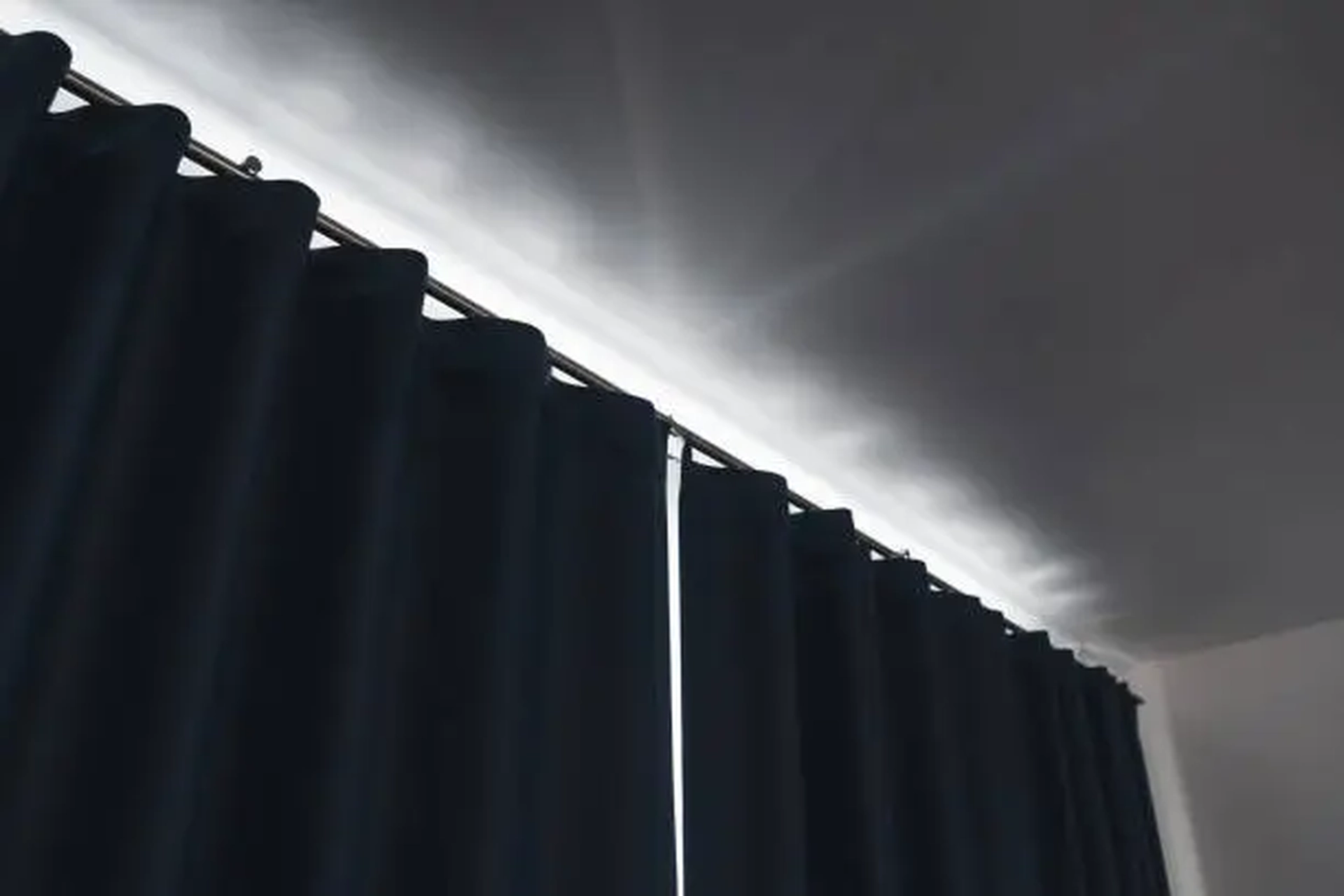
A bedroom is properly dark only when heavyweight, triple-weave (3-pass) blockout fabric, a track, pelmet or ceiling-mount fitting that stops light sneaking in over the top, and curtains cut wide and long enough to return fully to the wall at each end are all right together. Get one of those wrong and the fabric doesn’t matter. The room still won’t be dark.
Most people who come to Adek Blinds & Curtains about blockout curtains have already bought one, and it isn’t working the way the packet promised. Before you buy the next one, it’s worth understanding what the dark actually depends on.
How blockout fabric actually works
A blockout curtain is a curtain lined, backed or woven with an opaque layer that stops light passing through the fabric itself.
The strongest version is 3-pass (triple-weave) blockout fabric: three bonded layers, usually a decorative face, a black or grey middle layer and a backing, rather than a single layer of thick fabric or a basic blockout lining stitched to a lightweight face fabric.
The difference matters because a single-layer “blackout-look” fabric can still glow faintly under strong afternoon sun, while a proper 3-pass fabric doesn’t. Fabric alone gets you most of the way to a dark room. It doesn’t get you all the way; the other two failure points below explain the rest of the gap.
Why does light still get in around the sides?
Because the curtain isn’t wide enough, or isn’t returning to the wall. A curtain that stops at the edge of the window frame, rather than continuing past it and turning back to touch the wall, leaves a gap on both sides that daylight pours straight through, no matter how good the fabric is.
Getting this right just takes generous width and a proper return. Let the track or rod run well past the window frame on each side (curtains that fully cover the window and overlap the wall by a decent margin usually do the job, though the exact figure depends on the window and the room), and make sure the leading edges overlap enough in the middle that they won’t gap once the fabric settles. Sizing the curtain to the window opening instead of the wall either side of it is by far the most common reason a “blockout” curtain doesn’t actually block anything out.
Why does light leak in over the top?
This is the one people notice last and mind most, because it’s the strip of light across the ceiling at 5am. It happens because a standard curtain track, mounted a short distance below the ceiling, leaves a gap between the top of the fabric and the ceiling itself. That gap is exactly where morning light gets in.
There are two proper fixes, and they’re not the same job:
- A pelmet: a boxed cover that sits above the track and closes off that gap completely, whatever hardware sits behind it. It’s the most reliable fix and adds a finished, tailored look to the window, at the cost of a small amount of extra joinery and ceiling height.
- A ceiling-mount (or ceiling-fixed) track: fitted flush to the ceiling rather than a drop below it, so there’s very little gap left to leak through in the first place. It’s a cleaner, more contemporary look than a pelmet and suits most Central Coast renovations, though it needs the ceiling itself to be sound enough to fix into.
A standard wall-mounted track with no pelmet and a visible gap above it is the configuration that leaves people saying blockout curtains don’t really work, when the fabric was never the problem.
Curtain width and fullness for full blackout
This is a separate question to the return covered above.
Fullness is how much fabric is gathered into the heading relative to the width of the track, and it makes a real difference to how dark the room gets.
- A flat, barely-gathered curtain lets light through wherever the pleats sit slightly open.
- A fuller curtain closes those gaps by sheer weight of fabric.
Bedroom blockout curtains generally want to sit on the fuller side of normal, with a heading (pinch pleat, S-fold or wave) that closes flat rather than one designed to fan open.
Choosing between a pelmet and a ceiling-mount track
One or the other is usually enough. A pelmet suits a room where you want a more traditional, finished look, or where the ceiling isn’t suitable for a flush-fixed track. A ceiling-mount track is the option Bryn reaches for on most new-build and recently renovated bedrooms on the Central Coast, because it disappears into the ceiling line rather than adding to it.
| Fitting | Blocks top light-bleed | Look | Best suited to |
| Standard track, wall-mounted, no pelmet | Poor: visible gap above the fabric | Track and rings visible | Living areas where total dark isn’t the goal |
| Pelmet over a standard track | Very good: gap fully boxed in | Tailored, traditional | Bedrooms in period or heavier-styled homes |
| Ceiling-mount (ceiling-fixed) track | Very good: minimal gap to begin with | Clean, contemporary | Bedrooms in new builds and modern renovations |
Pairing blockout curtains with a blind or shutter
Sometimes, particularly on a west-facing bedroom window that gets hard afternoon sun. A roller blind or plantation shutter behind the curtain adds a second layer that helps with heat and any residual edge light on the brightest days. Plenty of rooms don’t need it; a curtain sized and fitted properly is often enough on its own. If you’re weighing curtains against a blind as the room’s main covering rather than as a pair, our comparison of sheer and blockout curtains goes through where each one earns its place.
Blockout curtains and heat control
They help with heat for the same physical reason a pelmet stops light. The Australian Government’s YourHome glazing guidance notes that heavy curtains combined with a pelmet, or another close fit at the top, create a sealed layer of still air against the glass.
That still-air layer does most of the work in reducing heat transfer through a window, in both directions. A curtain that leaks light at the top is, by the same physics, leaking heat through the same gap.
Cost: blockout curtains versus standard curtains
There’s a real cost difference, and it’s driven by the same three things that determine whether the room goes dark:
- the fabric (3-pass blockout costs more per metre than a single-layer face fabric)
- the fitting (a pelmet adds joinery; a ceiling-mount track needs a sound ceiling and more careful installation than a standard wall track)
- the width and fullness needed to get a proper return
A cheaper option that skips the return, uses a lighter fabric or leaves the top open will cost less up front and simply won’t do the job it was bought for.
It’s worth thinking about the cost over the life of the curtain rather than the invoice alone. Julie had her bedroom curtains made by our team thirteen years ago. The quality has stood the test of time. A curtain that’s still doing its job well over a decade later is the cheaper option in the long run, even where the upfront price was higher.
If you’re ready to get the numbers for your own bedroom, book a free in-home measure and quote. Bryn will tell you honestly whether a pelmet or a ceiling-mount track is the better fit for your ceiling. No pressure to decide on the day.
Common mistakes with blockout curtains
The same three, repeatedly:
- sizing the curtain to the window rather than to the wall either side of it
- fitting a standard track with no pelmet or ceiling-mount fix for the gap above it
- choosing a fabric that’s blockout in name but only a single layer.
Any one of the three undoes the other two.
Frequently asked questions
Do blockout curtains have to be a dark colour?
No. The opacity comes from the lining or the weave, not the face colour. A pale or patterned face fabric with a proper 3-pass backing blocks light just as well as a dark one.
Can you add blockout lining to curtains I already own?
Often, if the existing curtains have enough fullness and the right heading to take a relined treatment. Whether that’s worth doing versus starting fresh depends on the curtain’s current fit.
Will blockout curtains stop noise as well as light?
They’ll take the edge off some external noise, since heavy fabric and a sealed top and sides reduce sound the same way they reduce light and heat; they’re not a substitute for proper acoustic treatment.
Can blockout curtains be motorised?
Yes. Our custom blinds and curtains installers can fit Somfy motorised systems on curtain tracks where a bedroom window is hard to reach, very wide, or the household wants one-touch control night and morning.
How much fuller should a blockout curtain be than a sheer curtain?
Fuller, not less: a flatter, less-gathered curtain leaves gaps at the pleats a sheer curtain doesn’t need to worry about. The right fullness depends on fabric weight and heading style, which is worth checking against the actual window rather than a rule of thumb.
When is it worth getting a professional measure for blockout curtains?
As soon as the room needs to be properly dark and not just dimmer. Getting the width, the return and the top fitting right the first time is the difference between a curtain that works and one that doesn’t, and none of the three can be fixed after the fact without redoing the job.
Bryn, owner and installer at Adek Blinds & Curtains has been measuring and fitting bedroom curtains on the Central Coast since 1986, and he’ll tell you plainly whether your ceiling suits a pelmet or a ceiling-mount track before you spend anything.
Book a free in-home measure and quote. The sample box stays with you overnight if you want to see how a fabric looks in your own bedroom light.