
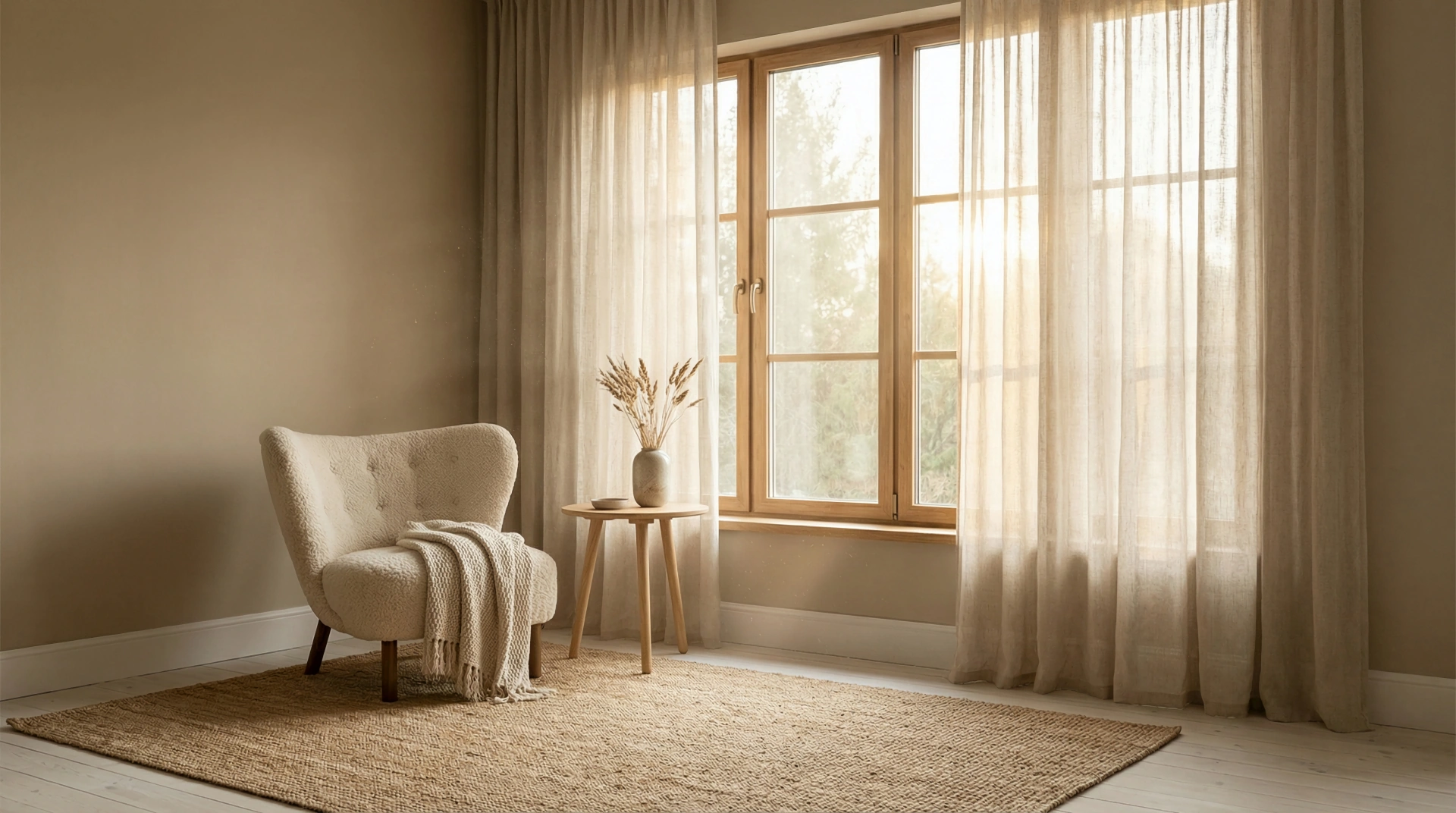
Sheers soften daylight and give you privacy during the day without darkening the room. Blockouts kill light completely for sleep, glare control, and any room with a screen in it. Most Central Coast living rooms want both on a double track. Most bedrooms want a blockout, often with a sheer added for the daytime look and the morning light. The honest answer is rarely one product over the other; it is a room-by-room call.
This is the comparison we walk every client through on the kitchen table during a measure, because the right choice is about matching the product and the fabric to how you actually use the room.
The honest short answer
A sheer is a filter. A blockout is a wall. Filters are for rooms you use during the day, rooms with a view worth keeping, and rooms where you want soft light and a beautiful finish. Walls are for rooms you sleep in, watch films in, or sit in during a hard afternoon sun.
If you only read one paragraph, bedrooms get a blockout, often paired with a sheer. Living rooms with a view get both. Kitchens and bathrooms usually suit a blind or shutter instead of a curtain. Media rooms and home offices with monitors get a blockout. Every other room is a judgment call based on aspect, fabric, and how you actually use it.
What each product actually does
Sheer curtains
Sheer curtains are a lightweight, semi-transparent fabric (voile, linen sheer, polyester voile) that lets diffused light into the room while blurring the view in and out. A standard residential sheer runs at about 120 to 180 grams per square metre. A denser privacy-weave linen sheer runs at 220 to 250 gsm, and the fabric weight is the biggest single decision, because it sets how the curtain looks, drapes, and performs.
Sheers do five things well:
- Soften daylight. They diffuse direct sun into a softer wash without darkening the room.
- Give daytime privacy. When the outside is brighter than the inside, sheers blur the view from the street into a soft haze.
- Cut glare and UV. A medium-weight sheer can drop afternoon glare by 50 to 70 per cent and filter most of the UV that fades floors and furniture.
- Add visual softness. Sheers introduce vertical lines and fabric movement that make a hard-edged contemporary room feel finished. They are the defining curtain look in renovated Australian homes right now.
- Help with heat. Any fabric over glass helps slow the heat moving through the window. Heavier and denser fabrics do more, and where thermal performance matters for a specific room, Bryn can assess it on site and suggest the right fabric weight or an additional product for that window.
How much privacy a sheer gives at night depends on the fabric and your interior lighting denser privacy weaves hold good evening privacy in most rooms, while lighter voiles are best paired with a blockout layer behind. We cover the detail in our post on sheer curtains and privacy at night (Blog 1 in this series).
Blockout curtains
Blockout curtains are a heavyweight fabric backed with a coated lining that stops light passing through. A 3-pass blockout (three layers of coating) is the specification we fit on bedroom and media room jobs across Terrigal, Wamberal, Killcare and Macmasters.
Blockouts do four things well:
- Kill light. A properly fitted blockout takes a bedroom to sleeping dark even at midday.
- Insulate. The Australian Government’s home design guidance on glazing notes that homes can lose up to 40 per cent of their heating energy and gain up to 87 per cent of their summer heat through windows; a lined blockout sits between you and that loss.
- Block noise. Heavy fabric absorbs mid-range sound. It will not silence a coastal road, but it takes the edge off.
- Give full nighttime privacy. Lights on, blockout drawn, nothing visible from outside.
They do not let any light in when closed (the point), they look heavy in a small or low-ceilinged room, and in a living space you use during the day they work best with a sheer in front rather than on their own.
Sheers, sorted: where they shine
Sheers earn their place in any room where you want daylight without exposure, and where the look and the view matter. Practically, that means:
- Living rooms and dining rooms with a view. Especially anything facing water, which on the Coast is most of the premium housing stock from Killcare to Wamberal. The view is why people bought the house. Sheers protect it without compromising it.
- Front-of-house formal rooms. Daytime privacy on the street side with a softer, more contemporary finish than a heavier curtain and a denser privacy weave carries that privacy into the evening.
- Hallways and stairwells with windows. Soft daylight, no afternoon hot spot.
- Bedrooms. A sheer paired with a blockout gives the best of both soft morning light and the daytime look, total darkness when you want it. Sheer on the front track, blockout behind.
- Any room where fabric choice does the work. For rooms used mostly in softer evening light, a denser privacy-weave sheer on its own is often all the room needs.
Blockouts, sorted: where they belong
Blockouts earn their place anywhere darkness or thermal performance is the brief. Practically:
- Master bedrooms. The single most common blockout install and increasingly paired with a sheer for the daytime.
- Kids’ bedrooms. Particularly for younger kids whose sleep depends on early-morning darkness.
- Media and theatre rooms. Where any ambient light kills the picture.
- Home offices and studies. Where afternoon glare on a monitor is unworkable.
- Western-aspect living rooms. The afternoon sun on a Central Coast west-facing room can be relentless from October to March. A heavy blockout ideally behind a sheer so the room still works during the day cuts the heat gain meaningfully.
Where a blockout works best with a partner:
- Living rooms with a view you want during the day. Adding a sheer in front gives you the option of both.
- Small or low-ceilinged rooms, where a lighter layered look stops the fabric weight overwhelming the room.
When both make sense (the double-track logic)
For most living rooms and most master bedrooms on a Central Coast premium renovation, the answer is both. A double track lets the sheer hang in front for daytime view and glare control, and a blockout behind for nighttime privacy, full dark, and thermal performance. We cover the physics of this in detail in our post on sheer curtains and privacy at night (Blog 1 in this series).
The setup looks like this:
| Track | Fabric | Job |
| Front (closer to room) | Sheer | Daytime privacy, glare and UV control, softening, the look |
| Back (closer to glass) | 3-pass blockout | Nighttime privacy, full dark, insulation |
Both tracks usually tuck into the same ceiling rebate, so the room sees one clean architectural line.
A practical alternative, when reveal depth does not allow two tracks, is a sheer on a single track with a blockout roller blind in the reveal behind it. The roller drops down for nighttime privacy and disappears behind the sheer during the day.
For tall windows or multi-track runs above a staircase, adding motorisation to the blockout track is worth the spend. Manual is fine for a standard bedroom; motorised earns its place on the high or hard-to-reach jobs.
Room-by-room recommendation
| Room | Recommended setup | Why |
| Master bedroom | Sheer with blockout on a double track, or blockout alone | Sleeping dark, with optional soft morning light |
| Kids’ bedroom | Blockout, cordless or motorised | Dark sleep, plus mandatory child safety |
| Living room with a view | Sheer plus blockout on a double track | Daytime view, nighttime privacy, glare control |
| Living room without a view | Sheer, denser privacy weave, or layered depending on aspect | Softness and flexibility, matched to how the room is used |
| Dining room | Sheer (often), blockout if west-facing | Atmosphere and daytime softness |
| Study or home office | Blockout, often layered with a sheer | Monitor glare control with a softer daytime finish |
| Media room | Heavy blockout with side returns | Full dark for AV |
| Kitchen | A blind, not a curtain | Easy-clean, fire-safe near cooktop |
| Bathroom | A shutter or PVC blind, not a curtain | Steam and humidity suit hard finishes better than fabric |
| Hallways and stairwells | Sheer (if any) | Soft daylight without blocking circulation |
The mistakes we see most often
These are the four spec calls we fix most often when customers come back to redo what an earlier installer got wrong.
- Choosing a light voile where a denser privacy weave suited the room. The fabric weight is the decision get it right and the sheer does everything the room asked of it.
- Putting a blockout on its own in a living room with a water view. You lose the reason you bought the house every time the curtain is drawn for glare. A sheer in front gives you the view and the glare control at once.
- Not planning stack-back clearance. On a double track, both layers need somewhere to bunch when open measured properly, the stacked fabric frames the window instead of covering it. If thermal performance matters to you, the federal guidance on windows and energy loss is worth a read.
- Specifying a single-pass blockout to save money. It looks fine for two years and then fades, sags and lets light through pinholes. We use 3-pass as standard for that reason. The longevity is the point; we still have curtains from 2013 hanging in customer bedrooms across the Coast.
If energy performance is a meaningful part of why you are looking at curtains, our post on why blinds and curtains matter for comfort and energy savings in Central Coast homes goes deeper into the thermal side.
Common questions
Are double curtains worth the extra money? For living rooms with a view and master bedrooms, almost always yes. A double track gives you both products’ performance in one install. The premium over a single curtain is typically 30 to 50 per cent more on the curtain side, not double the total job.
Can I add a sheer to existing blockouts later? Sometimes. It depends on the reveal depth, the existing track type, and whether the original install left room for a second track. We can almost always work something out. Most fixes need a measure visit to confirm.
What about an S-fold blockout, does it perform differently? S-fold is a heading style, not a fabric specification. An S-fold blockout in 3-pass fabric blocks light identically to a pinch-pleat 3-pass blockout. Choose S-fold for the clean contemporary look it gives on a ceiling-mounted track; the function is the same.
Do sheers actually reduce heat in summer? Yes a medium-weight sheer cuts about 20 to 30 per cent of solar heat gain, and any fabric over glass helps slow heat transfer year-round. A lined blockout cuts more again. For real heat-control performance on a west-facing room, the answer is the blockout (or, outside, a Zipscreen on the verandah (link optional if Awnings is being internally linked here)).
Which fabric brands do you supply? Our curtain fabrics come from Nettex, James Dunlop, Hoad and Warwick. For motorisation and awning hardware we work with Somfy and Hunter Douglas. Bryn will bring the sample box to your house and you can take fabric back to the room you are trying to dress and live with it for a week before deciding.
If you want someone to walk through the rooms with you and call the right setup for each one (no pressure to decide on the day, no scripted sales pitch), Bryn has been in the industry for over 25 years. A free in-home measure and quote is the simplest way to work out what each room actually needs.