
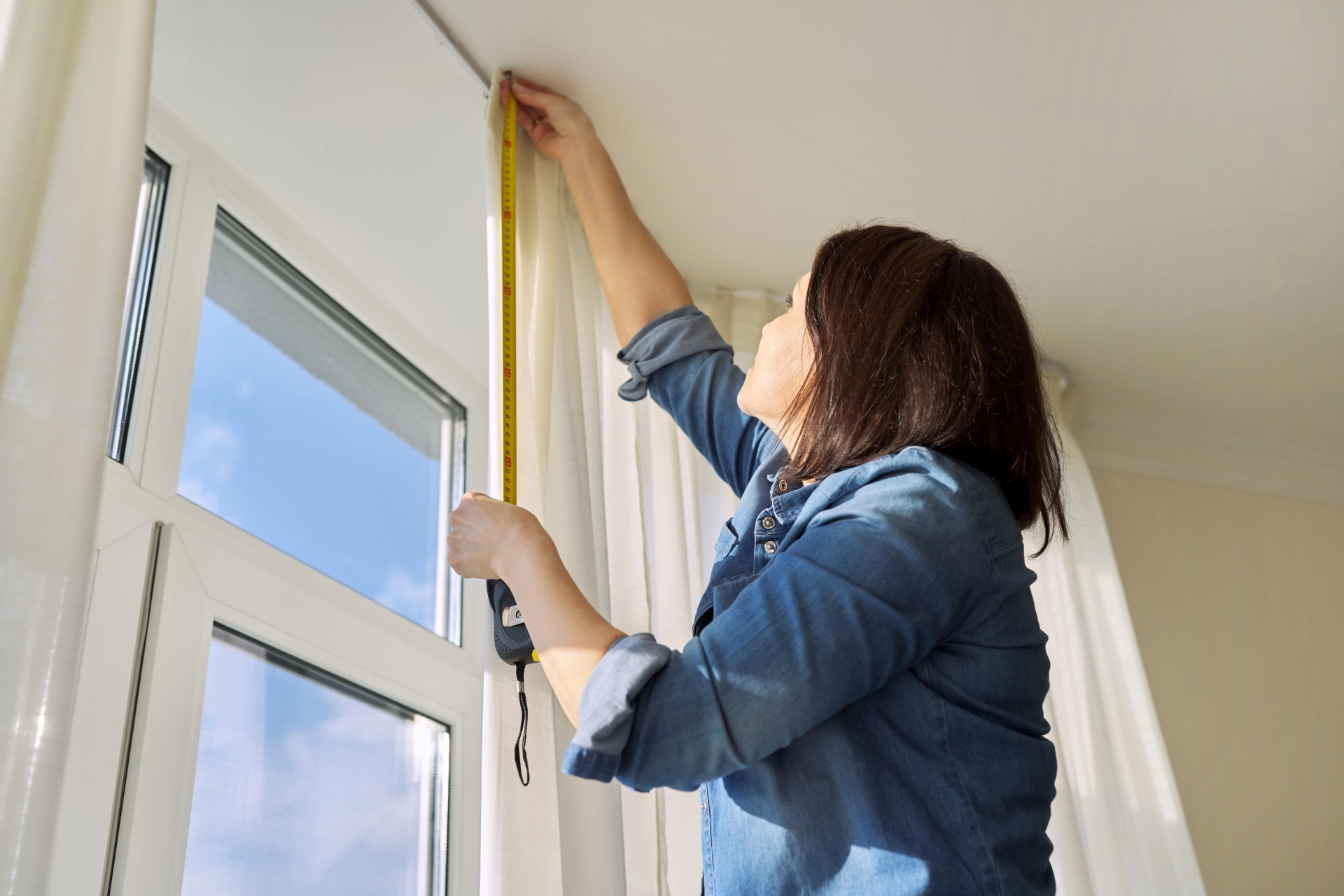
Measuring curtains looks simple until a tape measure, a window frame and a skirting board start disagreeing with each other.
A few millimetres can change how curtains hang, stack, glide and cover a room.
So, before you order fabric or pick a heading style, here is how to measure curtains properly.
What Does It Mean To Measure Curtains Properly?
To measure curtains properly, you need to measure the window width, the desired track or rod position, the curtain drop and the space needed for the curtains to stack when open.
That sounds straightforward, but accurate curtain measuring is about more than the glass size.
You are measuring how the curtains will work in the room. That includes privacy, light control, airflow, furniture placement, wall space and the final look.
For custom curtains, the measurement should account for:
- Track or rod width: This decides how far the curtains extend beyond the window.
- Curtain drop: This determines whether the curtains finish at the sill, below the sill or near the floor.
- Stacking space: This allows curtains to sit neatly beside the window when open.
- Wall and ceiling conditions: Uneven surfaces can affect how tracks are installed.
- Room function: A bedroom usually needs better coverage than a casual living area.
That is why professional measuring still matters. The tape measure gives the numbers, but the room gives the context.
How To Measure Curtains For Width Without Guesswork
When learning how to measure curtains, width is usually the first measurement to take.
You should not measure only the glass. In most cases, curtains need to extend beyond the window frame so they block light better, provide more privacy and sit neatly when open.
A common approach is to measure the full width of where the track or rod will sit, then allow extra width on each side of the window. This extra width is often called overlap or stacking space.
Here is a simple guide.
| Measurement Area | What To Measure | Why It Matters |
| Window frame width | The full outer edge of the frame | Gives a basic starting point |
| Track or rod width | The planned full curtain span | Determines curtain coverage |
| Side overlap | Extra space past each side of the frame | Helps reduce light gaps |
| Stacking space | Wall space for open curtains | Keeps more glass exposed when curtains are open |
For many homes, adding extra width gives a much cleaner result. Curtains that only cover the exact frame can look tight, and nobody wants curtains that appear to be holding their breath.
This is especially important if you are comparing styles through custom curtains for your home, because sheer curtains, blockout curtains and lined curtains can all need different amounts of fullness.
Fullness is the amount of fabric used compared with the track width. A curtain with more fullness looks softer and more generous, while too little fullness can look flat.
As a general guide, sheers often need more fullness than blockout curtains because their appeal comes from soft folds and movement. Heavier curtains may need less fullness, depending on the heading and fabric weight.
How To Measure Curtains For The Right Drop
The drop is the vertical measurement from the top of the curtain position to where the fabric should finish.
This is where small mistakes become very visible. A curtain that is too short can look accidental. A curtain that is too long can drag, gather dust or interfere with doors and vents.
Before measuring the drop, decide where the curtain will start. This may be from a wall-mounted track, a ceiling-mounted track or a decorative rod.
Then decide where the curtain should end.
Common curtain drops include:
- Sill length: The curtain finishes at or just above the window sill, which can suit kitchens, bathrooms or smaller windows.
- Below sill length: The curtain finishes slightly below the sill, giving more coverage while still staying off the floor.
- Floor length: The curtain finishes just above the floor, which gives a clean and tailored look.
- Puddled length: The curtain rests slightly on the floor, creating a softer decorative effect, although it needs more maintenance.
For most practical homes, floor-length curtains that sit just above the floor are a popular choice. They look polished and are easier to clean around.
The Australian Government’s guidance on passive design shading explains how shading can help manage heat and sunlight, which is worth considering when deciding whether curtains should sit higher, wider or closer to the wall for better coverage.
If the room receives strong afternoon sun, a careful drop measurement can also reduce light leakage around the top and bottom of the curtain.
How To Measure Curtains Around Tracks, Rods, And Hardware
Hardware changes the measurement.
A curtain track usually creates a different finished height from a decorative rod with rings. Ceiling tracks can make a room feel taller, while rods can add a more traditional look.
When measuring, you need to know which hardware will be used before finalising the curtain size. Otherwise, the finished curtain can sit too high, too low or slightly awkwardly in between.
For example, if curtains are measured for a rod but later installed on a track, the drop may not be right. The heading may also sit differently.
Here is a quick comparison.
| Hardware Type | Measurement Consideration | Best Used When |
| Wall-mounted track | Measure from the top of the track position | You want a simple, discreet finish |
| Ceiling-mounted track | Measure from ceiling height to the desired drop | You want height and a cleaner line |
| Decorative rod | Measure from the rod or ring position | You want the hardware to be visible |
| Motorised track | Measure with power access and clearance in mind | You want easier operation for large curtains |
This is one reason Adek Blinds & Curtains still measures every window before ordering. A home may look simple at first glance, but the track position, wall surface and ceiling line can quickly change the best solution.
For homeowners looking at examples of finished installations, browsing recent curtain projects can make it easier to see how different tracks, drops and folds affect the final look.
A curtain is not just fabric. It is fabric behaving well because the hardware, measurements and installation all agreed to cooperate.
How To Measure Curtains When Windows Are Not Perfectly Square
Most windows are not as straight as they pretend to be.
Older homes, renovated rooms and coastal properties can have small variations in ceiling height, wall angle or floor level. Even newer homes can have minor differences between one side of a window and the other.
That means one measurement is rarely enough.
A better method is to measure the width and drop in several places. For the drop, measure on the left, centre and right. For width, measure at the top and across the intended track location.
This helps reveal whether the window, floor or ceiling is uneven.
Here is a simple measuring process:
- Measure the full width at the intended track position: This gives the most relevant width for the finished curtain.
- Measure the drop in three places: Left, centre, and right. Measurements can reveal uneven floors or ceilings.
- Check nearby obstructions: Air-conditioning units, power points, shelves and furniture can affect the curtain position.
- Allow for doors and handles: Sliding doors and hinged doors need clearance so that curtains work smoothly.
- Record the room and window location: This helps avoid mixing up measurements between similar rooms.
For local homes where window styles vary widely, such as when choosing curtains in Gosford, a professional measure helps avoid assumptions based on “standard” window sizes that may not be standard at all.
The Australian Government’s information about energy-efficient homes is also relevant here, because well-fitted window coverings can form part of broader decisions around comfort, heat and cooling.
Better measuring does not just improve appearance. It can also help curtains perform properly.
How To Measure Curtains For Privacy, Light, And Daily Use
The best curtain measurement depends on how the room is used.
A bedroom may need blockout coverage to reduce morning light. A living room may need sheers for daytime privacy. A home office may need glare control for screens. A nursery may need darkness, safety and simple operation.
This is why measuring should include lifestyle questions, not just numbers.
For example, curtains in a bedroom may need to extend wider and higher than the window to reduce light gaps. In a lounge room, the priority may be soft filtered light, so a sheer curtain with generous fullness could be the better fit.
For homes around Wyong, where open-plan spaces and sliding doors are common, selecting curtains in Wyong often means thinking about how the curtain will stack during the day as much as how it will cover the glass at night.
Good measuring also considers how often the curtains will move. Curtains that are opened every morning and closed every evening need reliable tracks, suitable fabric weight and enough clearance.
A few practical questions help shape the measurement:
- Do you need privacy during the day? Sheers may need to cover a wider span for a soft, consistent look.
- Do you need darkness at night? Blockout curtains may need extra overlap at the sides and top.
- Is there furniture near the window? Sofas, beds and desks can affect the ideal drop and stacking position.
- Will children or pets use the room? Practical fabric lengths and safe operation become more important.
- Does the room get hot? A wider and higher curtain position may improve coverage against sun exposure.
The right measurement turns curtains from decoration into something useful, comfortable and easy to live with.
Why We Still Measure Every Window Ourselves
Measuring your own curtains is helpful for planning, but it is not the same as a professional check before ordering.
Adek Blinds & Curtains measures every window because custom curtains are made to specific dimensions. Once fabric is cut and sewn, there is very little room for “close enough”.
Professional measuring helps confirm the final track position, drop, fullness, fabric suitability and installation requirements.
It also helps avoid common issues such as:
- Curtains finishing at the wrong height: Even a small drop error can look obvious.
- Insufficient stacking space: Curtains can block too much glass when open.
- Light gaps around the frame: Poor overlap can reduce privacy and blockout performance.
- Hardware clashes: Handles, shelves, tiles and air-conditioning units can interfere with the curtain.
- Uneven finished lines: Floors and ceilings can create surprises that a single measurement may miss.
There is also a consumer protection angle. Under consumer guarantees, services should be provided with due care and skill, which is one reason proper measuring and clear quoting matter.
When you are ready to discuss measurements, fabric and fit, speaking with Adek is the most reliable way to turn rough measurements into a practical curtain plan.
You can still measure at home to set expectations. We recommend it. Just do not let one quick number decide the final order.
A tape measure is useful. Experience is what stops the tape measure from getting too confident.
Measuring Curtains Is Simple, Until It Needs To Be Exact
Knowing how to measure curtains gives you a better understanding of cost, style, and what will work in your home.
The basics are width, drop, hardware position, stacking space and room function. The finer details are uneven floors, sun exposure, fabric behaviour, wall conditions and how the curtains will be used every day.
Adek Blinds & Curtains offers stylish and functional blinds and curtains that improve privacy, sun protection and the overall appearance of your home. When your rough measurements are ready, contact us today to arrange a proper measure and discuss the best curtain solution for your space.
A well-measured curtain looks effortless. That is usually because someone did the careful bit before the fabric ever reached the window.