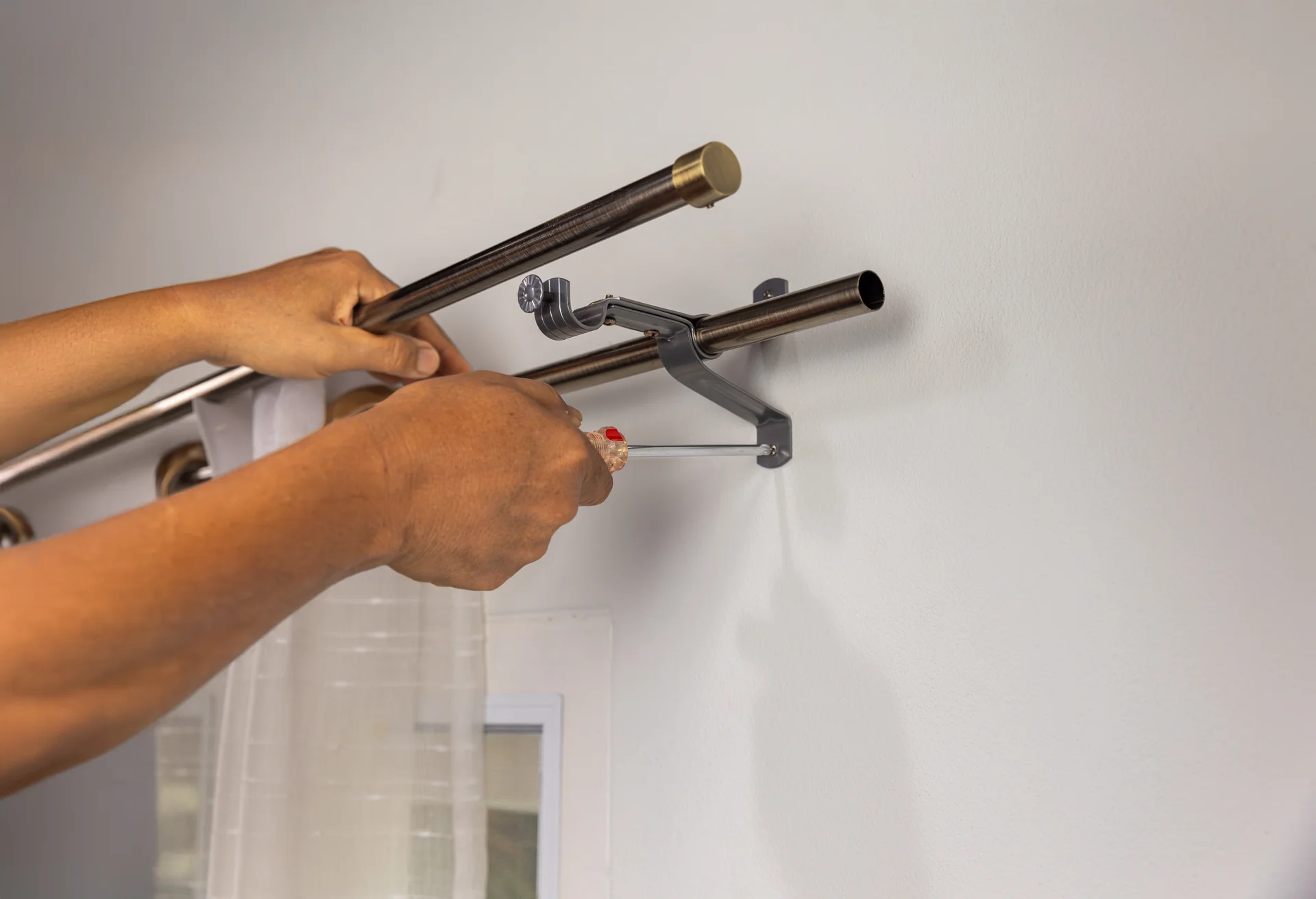
A track disappears into the ceiling or wall for a clean, contemporary line and carries heavier curtains better. It’s the default Bryn reaches for on most Central Coast new builds and renovations. A rod stays visible as a feature in its own right, which suits heritage windows and decorative heading styles like eyelet or tab-top. The real technical difference is weight capacity and whether you want the hardware seen or hidden. Everything else follows from that.
Most people ask this question partway through choosing curtains, once the fabric and heading style are more or less decided and the hardware becomes the next thing to sort out. Below is how Bryn at Adek Blinds & Curtains actually decides between the two on a Central Coast job, including where each one runs into trouble.
The short answer, before the detail
If the priority is a hidden fixing, a heavier or fuller curtain, or motorisation, choose a track. If the priority is a visible, decorative finish, or you’re working with a heading style built to show off the hardware, choose a rod. Most Central Coast renovations and new builds land on a track by default, simply because the curtains being specified are fuller and heavier than the rooms they were built for fifty years ago, and rods have a real weight ceiling a track doesn’t.
Curtain track vs curtain rod: the core differences
A track is a channel, usually aluminium and sometimes with a decorative pelmet board hiding it, that carries gliders or hooks along its length, out of sight once the curtain is hung. A rod is a pole, exposed along its full length, that the curtain hangs from directly using rings, eyelets or tabs, with the rod itself visible as part of the room’s finish.
| Curtain track | Curtain rod | |
| Visibility | Hidden by the curtain heading or a pelmet | Visible along its full length |
| Typical weight capacity | Higher: built for fuller, heavier fabric | Lower: sags or bows under heavy fabric over a long span |
| Common heading styles | Pinch pleat, S-fold, wave | Eyelet, tab-top, pencil pleat, pocket |
| Motorisation | Straightforward to motorise | Rarely motorised |
| Curved or bay windows | Bends to follow the wall | Generally straight runs only |
Real-world performance and durability
This is where the spec-sheet difference turns into a lived-in one. A well-fitted track glides quietly and holds its line over years of daily opening and closing, whether operated by hand, a cord, a wand or a motor. A rod is opened by sliding the rings or eyelets directly along the pole. That’s simple and reliable for a lighter curtain, but the friction of metal or timber on metal increases as the curtain gets heavier, and a rod under real load will bow in the middle of a long span over time in a way a properly bracketed track won’t.
Bryn fits Silent Gliss tracks on most Central Coast jobs: a Swiss-engineered system built specifically for heavier curtains and quiet, corded or motorised operation. That’s the main reason a track earns its higher price over a basic rod on a fuller curtain.
| In practice | Curtain track | Curtain rod |
| Day-to-day operation | Glides quietly on gliders; suits cord, wand or motorised control | Rings or eyelets slide directly on the pole; more friction as weight increases |
| Behaviour under a heavy curtain, over time | Holds its line when properly bracketed | Can bow or sag mid-span on a long run |
| Maintenance | Occasional glider check; little else | Occasional bracket check; more exposed to knocks since it’s visible |
| Noise | Quiet when properly installed | Can click or drag if rings aren’t matched to the pole finish |
Matching hardware to new builds, renovations and heritage homes
New builds and recent renovations on the Coast tend to have higher ceilings, larger glass and sliding doors onto a deck or pool, and curtains specified with enough fullness to properly dress that scale. This points towards a track, usually ceiling-mounted for the cleanest line, an approach the ACT Government’s Climate Choices guide to window treatments also backs, recommending close-fitting curtains and pelmets to help control heat transfer across large glass areas.
Older Federation, Californian bungalow and heritage-style homes more often have curtains as a visible design feature in their own right, with picture rails, decorative finials and a heading style meant to be seen. That’s where a rod, in timber or a period-appropriate metal finish, does the room more justice than hardware hidden behind a pelmet.
| New build / recent renovation | Heritage / period home | |
| Typical ceiling and window scale | Higher ceilings, larger glass | Standard ceilings, sash or casement windows |
| Usual hardware choice | Ceiling-mount track | Decorative rod |
| Reason | Disappears into a clean line; handles fuller curtains | Complements the home’s existing period detail |
Cost over the life of the curtain
A track generally costs more to buy and install than a basic rod, largely because of the bracketing and the glider mechanism, and a ceiling-mount system adds further cost again since the fixing needs extra precision. A rod is usually the simpler, lower-cost hardware for a lighter curtain on a shorter run.
The cost comparison changes once you factor in what happens under load. A rod carrying a curtain heavier than it was really built for will sag, bind or need replacing sooner than a properly specified track carrying the same curtain; at that point, the cheaper hardware has cost more, not less.
If you’d like Bryn to work out which one suits your actual windows, book a free in-home measure and quote. He’ll bring samples of both track and rod finishes.
Common mistakes when choosing between a track and a rod
Specifying a rod for a curtain heavier or fuller than the rod was built to carry is the most common one. It looks fine on install day and starts sagging within a year or two. Close behind it is choosing a heading style before the hardware: eyelet and tab-top headings are built around a visible rod and don’t sit well on a track, while pinch pleat and S-fold are built for a track’s hidden gliders and look unfinished threaded onto an exposed rod.
If you haven’t settled on a heading style yet, our comparison of S-fold, pinch pleat and eyelet curtains is worth reading before the hardware decision, since the two choices are made together, not in sequence.
Can curtain tracks and rods be motorised?
Tracks, readily. Adek Blinds & Curtains fits Somfy motorised systems on Silent Gliss and similar tracks where a window is wide, hard to reach, or the household wants one-touch operation. Rods can be motorised too, but the mechanisms are less common and more limited in the weight and span they’ll handle, which is another reason a track is usually the better base if motorisation is even just a maybe for later.
Are corded curtain tracks safe for children?
Any corded track or curtain mechanism installed in a home with young children needs to meet the relevant Australian safety requirements for corded window coverings: cords need to be inaccessible or fitted with a safety device, not left hanging loose within reach of a cot or bed.
The Australian Government’s product safety guidance on blinds, curtains and window fittings sets out what a compliant fitting looks like. For a bedroom or nursery specifically, Bryn generally recommends a cordless, wand-operated or motorised track over anything left hanging loose, and will talk through the options for your specific room.
Frequently asked questions
Can a curtain track be hidden behind a pelmet even if it’s not ceiling-mounted?
Yes. A wall-mounted or drop-mounted track can sit behind a pelmet board just as a ceiling-mount one can. The pelmet is what hides it either way, not the mounting height.
Do curtain rods work on sliding glass doors?
Generally not well for a heavy or full curtain across a wide sliding door. The span and weight usually suit a track, particularly if the curtain needs to glide easily every day rather than being purely decorative.
Is a curved or bay window a rod or a track job?
A track, in almost every case. Tracks bend to follow the wall; rods are built for straight runs and don’t curve cleanly around a bay.
Do I need a professional to fit a ceiling-mount track?
It’s worth having someone experienced check the ceiling can take the fixing and that the track sits level and square. A ceiling-mount track fitted slightly out of true is more noticeable than a standard wall-mounted one.
Which One Suits the Windows You’re Actually Fitting?
The short version is track for weight, a hidden finish and motorisation; rod for a visible, decorative feature on a lighter curtain. Most of the judgement calls sit in between those two answers, which is exactly the conversation Bryn has on every in-home measure, bringing samples of both and being direct about which one will actually hold up on your specific windows rather than which one is easier to sell.
Schedule a free home visit for an accurate quote or call 02 4368 2000, and our custom curtain installer will give you an honest recommendation for your windows.