
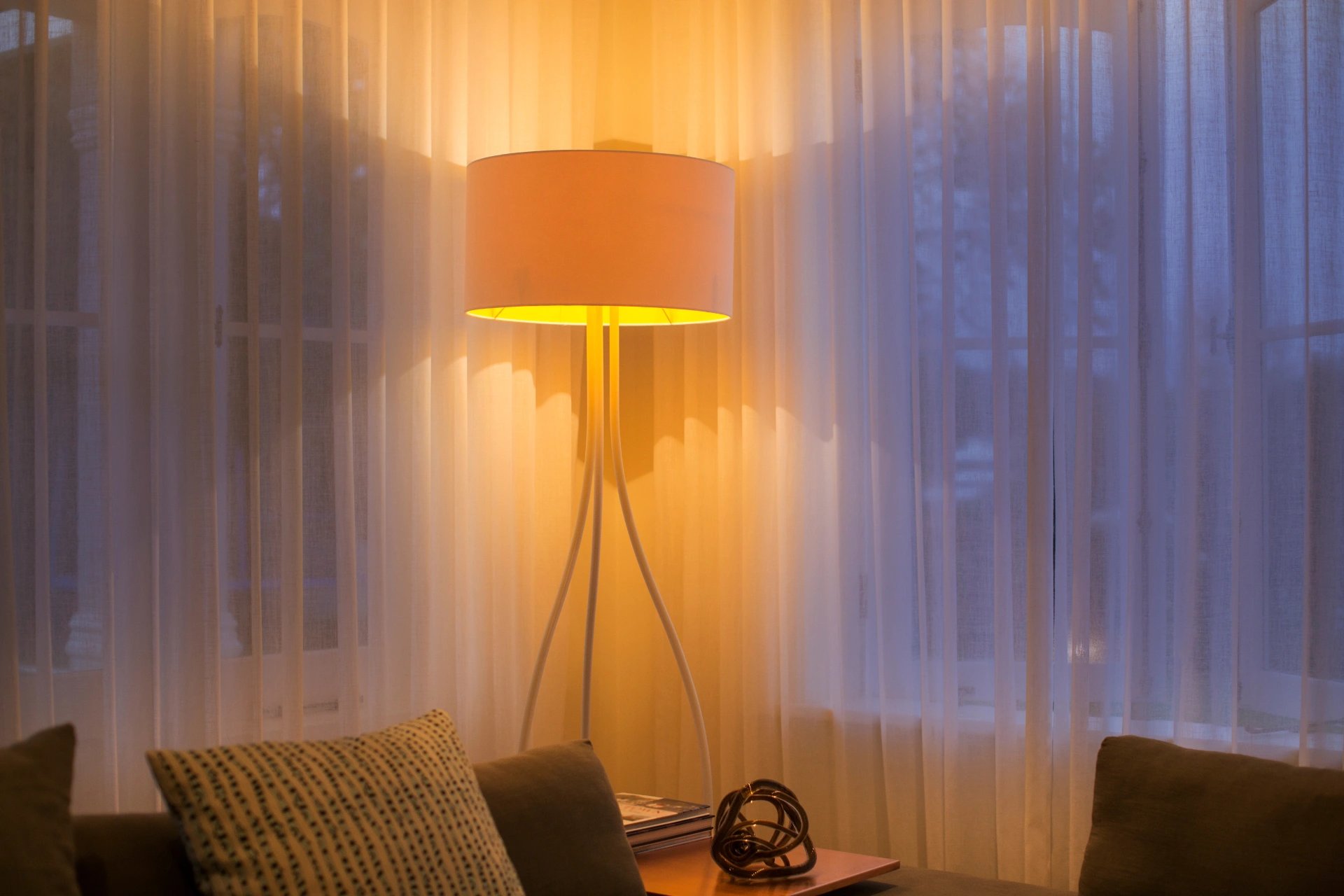
Yes with the right fabric and the right setup, sheer curtains can give you the privacy you need after dark. How much privacy comes down to two things: the density of the weave, and how bright your interior lights are. Some sheers are more open and suit a layered setup; denser privacy weaves hold their own well into the evening. It is a fabric decision, and it is exactly the kind of call Bryn makes at the window during a measure.
Sheers are the most popular curtains we hang right now, and for good reason. They soften the light, keep the view, and make a room feel finished. Getting the nighttime privacy right is simply a matter of choosing the fabric for the room and there is a sheer for almost every room.
What decides how private a sheer is at night?
Visibility through fabric is governed by which side has the brighter light source. During the day the outside is brighter than the inside, so light scatters off the outer face of the sheer and a passer-by sees a softly lit wall of fabric. In the evening that flips: your lamps become the brighter side, and how much definition passes through depends on the weave.
A light, open voile lets more of that light through. A denser privacy-weave fabric typically in the 220 to 250 grams per square metre range diffuses it substantially, and in a room with softer lamp light rather than bright downlights, many customers find that level of privacy is all they need. Lamp placement helps too: side lighting away from the window keeps the room reading as a soft glow from outside rather than a lit stage.
So the honest answer is not a flat yes or no it is “which sheer, and for which room?” That is a conversation worth having with the fabric samples in your hand, in your own light, at the time of evening you would actually be using the room.
What do sheer curtains do brilliantly?
Sheers earn their place in almost every room, which is why we specify them on most of the made-to-measure curtain work we do across Terrigal, Avoca Beach, Wamberal and Killcare.
Sheers do six things well:
- Daytime privacy. When the outside is brighter than the inside, sheers diffuse the view from the street into a soft blur. You can see out; the world cannot see in.
- Glare control. A medium-weight sheer takes the harsh edge off the afternoon sun without darkening the room. On picture windows facing water, this is often exactly what the room needs.
- Softening hard light. South-facing rooms in winter and any room with strong reflected light feel warmer and less clinical with a sheer in the frame.
- UV filtering. Sheers cut a meaningful share of UV that would otherwise fade timber floors, leather and artwork.
- Helping with heat. Any fabric over glass helps slow heat moving through the window in summer and winter both. Heavier fabrics do more, and if thermal performance is a priority for a particular room, Bryn can assess it on site and suggest the right fabric weight or an additional product for that window.
- The look. Sheers are the defining curtain style in renovated Australian homes right now. The soft vertical lines and gentle movement are what make a contemporary room feel finished.
And with the right fabric and setup, they can carry the privacy job after dark too. Here are the three ways to get there.
Which sheer setup suits which room?
There are three ways to get the nighttime privacy level you want, and all three keep the sheer front and centre.
Option 1: Sheer plus blockout on a double track
This is the setup we install most often. Two tracks are fitted parallel, one in front of the other. The sheer hangs on the front track and does the daytime work. The blockout hangs on the back track and gets drawn whenever you want total privacy and full darkness.
Done properly, the two tracks tuck into the same ceiling rebate, so you only see one clean line from the room. This is the setup we use on most living and bedroom jobs in renovated Central Coast homes the best of both worlds, every hour of the day.
Option 2: Sheer in front of a blockout roller blind
A space-saving alternative when there is not enough depth in the reveal for two tracks. The sheer hangs on a single track. A blockout roller sits behind it in the reveal. Drawn down at night, the roller gives full privacy. Pulled up during the day, it disappears behind the sheer.
This works well in older homes where the architrave depth makes a double track awkward, and on tall windows where the second track would compromise the install line.
Option 3: A denser privacy-weave sheer on its own
For plenty of rooms, one well-chosen sheer is the whole answer. A privacy-weave linen at 220 to 250 gsm, paired with sensible lamp placement side lighting rather than bright downlights near the window gives good evening privacy while keeping everything people love about sheers. It works especially well in formal lounges, dining rooms, front-of-house rooms on quieter streets, and any space used mostly in softer light. If you also want total darkness for sleeping, pair it with one of the blockout options above.
A quick reference
| Configuration | Daytime privacy | Nighttime privacy (lights on inside) |
| Light open-weave sheer alone | Good, outside brighter than inside | Best paired with a blockout layer behind |
| Sheer + blockout on a double track | Good (sheer drawn) | Excellent (blockout drawn) |
| Sheer + blockout roller behind | Good | Excellent (roller down) |
| Denser privacy-weave sheer alone | Very good | Good for most rooms, especially with softer lamp lighting |
| Blockout curtain alone | Total when drawn (also blocks light) | Excellent |
What we usually recommend on the Central Coast
For most Central Coast living rooms and master bedrooms, the double-track sheer-plus-blockout setup is the most popular call. It handles every hour of the day, looks clean from the room, and runs reliably for fifteen to twenty years if the hardware is specified properly. Where the window is over 2.7 metres tall or the track sits in a hard-to-reach run above a staircase, adding motorisation to the second track is worth the spend. Manual is fine on a standard bedroom; motorisation earns its place on tall and multi-track jobs.
A few practical notes from over 25 years in the industry:
- Track-mount, not face-fix, where possible. A ceiling-mounted track lets the curtain return to the wall, which closes the gap that lets light and view bleed in at the edges.
- Returns matter. The fabric should wrap around at each end and meet the wall it finishes the look and improves privacy at the edges.
- Stack-back clearance. On a double track, both layers need somewhere to bunch when open. Plan for it before the install.
- Hardware safety. Any corded curtain or blind in Australia must comply with the mandatory safety standard for corded internal window coverings, and we specify every installation accordingly. The NSW Government’s guidance on blind and curtain cord safety covers what the standard actually requires.
- Fabric care. Salt air is part of Coast life, and a quick care routine keeps sheers looking new for years. We cover the basics of looking after fabric window furnishings in coastal homes in a separate post worth bookmarking.
Common questions
Will a denser sheer give me privacy at night? Yes a privacy weave in the 220 to 250 gsm range gives good evening privacy in most rooms, particularly with softer lamp lighting rather than bright downlights near the window. If you also want total darkness for sleeping, pair it with a blockout on a second track or a blockout roller behind.
Can I use a blockout curtain on its own and skip the sheer? You can, and we fit some bedrooms that way. The trade-off is losing the daytime softening, glare control and the look that the sheer gives you, which is why most customers who see both in place choose the pair.
Do double curtains work on a single rod instead of two tracks? A double rod can work for an eyelet or tab-top informal look, but for pleated sheers and blockouts (the setup most renovated homes want), a double track is cleaner and operates better. Rods are a styling choice, tracks are an engineering choice.
What about S-fold sheers? Do they make any difference to nighttime privacy? S-fold is a heading style, not a fabric it changes how the curtain stacks and drapes, not the weave. Choose the fabric for the privacy level and the heading for the look; you can have both.
Which sheer fabrics do you work with? Our curtain fabrics come from Nettex, James Dunlop, Hoad and Warwick, which, between them, cover everything from light coastal voiles to dense privacy weaves. Bryn brings the sample books to your house so you can see each fabric in your own light before deciding.
If you want someone to walk through the rooms with you and call the right setup for each one (no pressure to decide on the day, no scripted sales pitch), Bryn can come out for a free in-home measure and quote. He has been in the industry for over 25 years, and most privacy questions can be answered in about 10 minutes at the window with the samples in hand.